

Sweet Earliest And Next To Largest Brother Steiff Donkey Esel 2 IDs
Original price was: $339.00.$99.99Current price is: $99.99.
- Quality You Can Count On
- 100% High-Quality Guarantee
- 7 days free returns
- We take quality seriously.

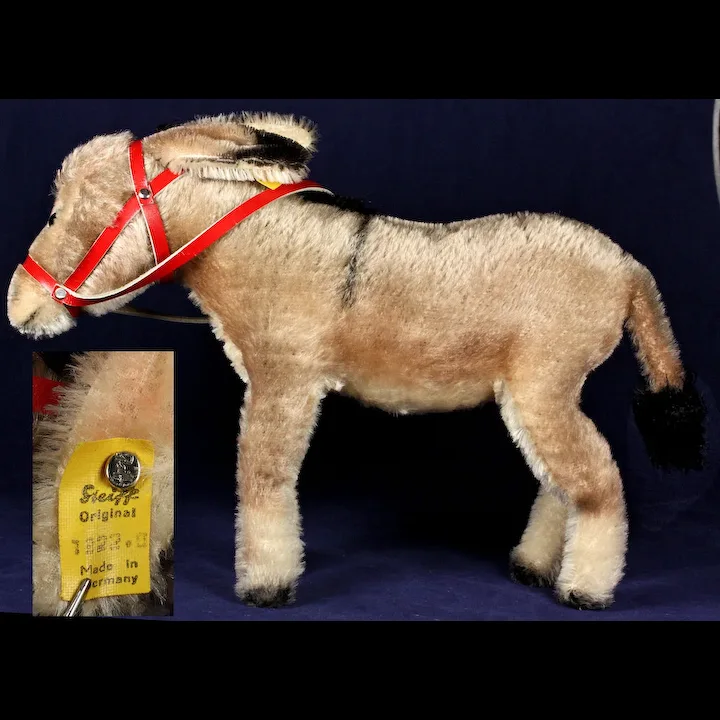
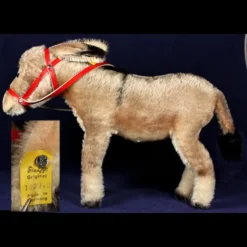
This sweet donkey (“Esel” in German and what I will call him here) is the next-to-largest member of the family. He joins his little brother, who is the smallest mohair Esel and the next to smallest member of the four-brother family. Not only is Esel bigger than his brother, but he is also older. I know that from his article number, 1322,0, the earlier of the two series of this donkey, made from 1950 to 1958. Because Esel has a raised script button, I am guessing that he was made no earlier than 1951.
Even if Esel were made in the last possible year of his series, he would already be well over 60 years old, and there is nothing about him that suggests such an age. To the contrary, I would say that he was in excellent-plus condition. I have gone down a notch from “near mint,” since Esel’s squeaker is silent, unless you give him a big whack in the belly; it does not produce a sound by the intended method of pressing in on his belly.
My rating of Esel is not using the (to me meaningless) expression “for his age.” I rate all my Steiff animals on an absolute scale, no matter when they were made. If you want to bring age into the discussion, you can say that Esel is in excellent-plus condition DESPITE his age.
Actually, in mentioning his squeaker, I have told you all there is to tell about Esel. That subject usually comes at the end of my description, when I point out—as I do now for Esel—his lack of voice will not be known to you or to any other person who stops by your vitrine and admires him on display.
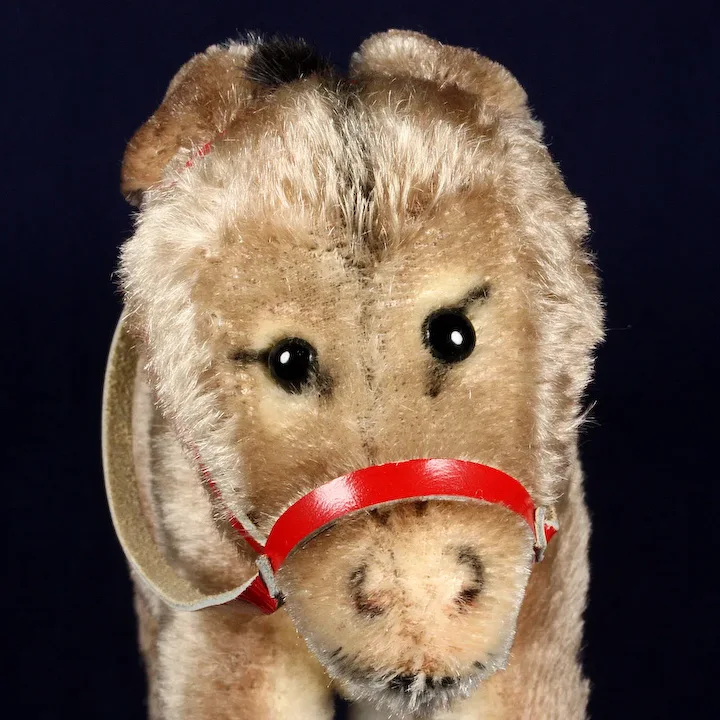
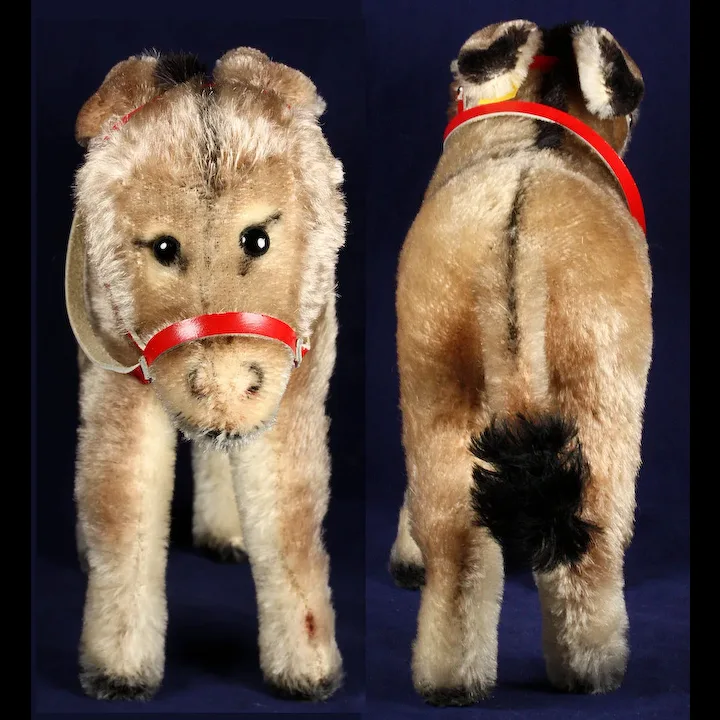
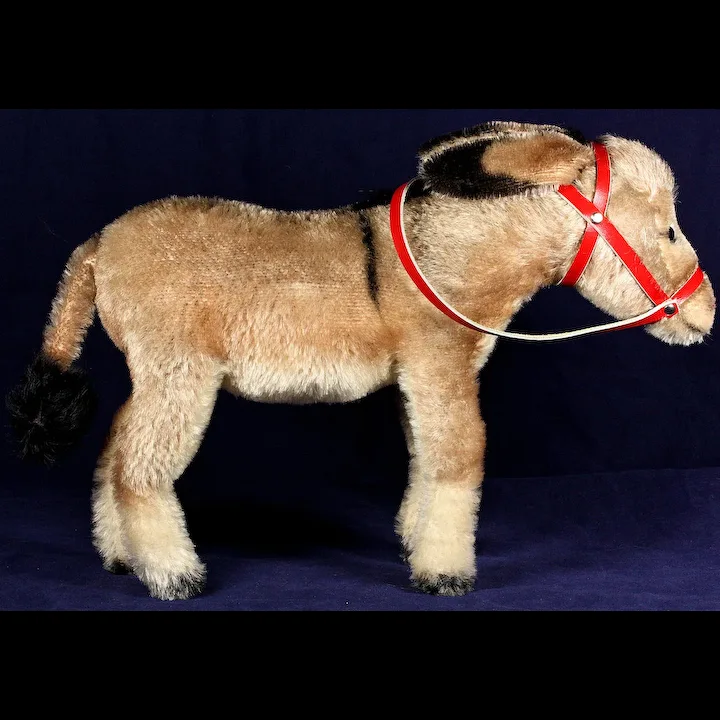
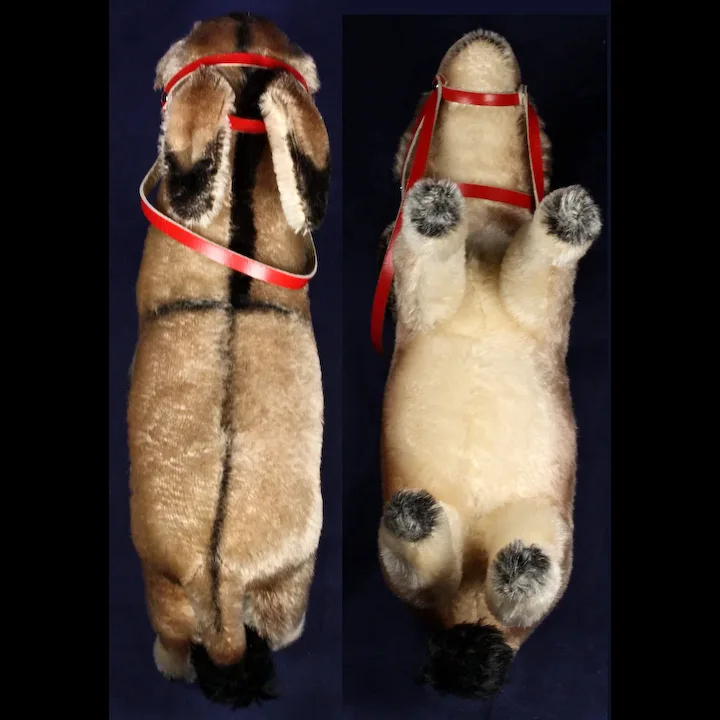
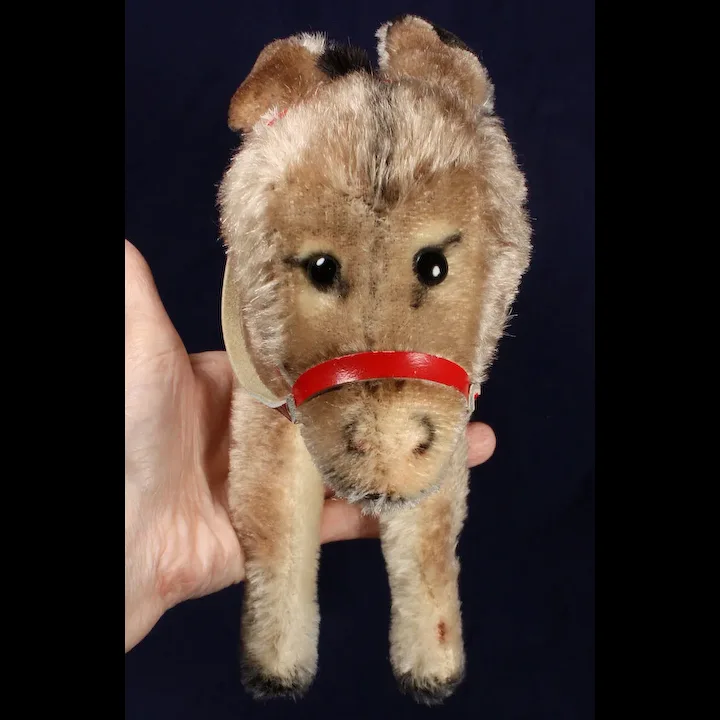
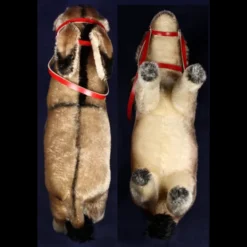
Everything else about Esel is fantastic. His mohair is full and lustrous, and his coloring is wonderful—including the black areas, like the backs of his ears, which could not have looked any blacker 60+ years ago when Esel left Giengen. Speaking of his ears, their white undersides are decorated with rose-colored airbrushed accents; I am showing you a bit of this in my inset image of his flag. I mentioned Esel’s black areas, but his white mohair seems just as pristine! See the right half of my fifth composite image.
One more feature (or is it features? ;-)) that looks new is/are his leather bridle and reins. There is no wear or cracking, or anything else that would suggest they were less than perfect.
The only thing left to tell you is Esel’s size. The “22” in his article number denotes his height in centimeters. If you measure to the top of his head, you get 21 centimeters, and if you include his ears, you get a little more. Obviously, you want to give him enough display room so that he will not feel (or look) cramped. I think he needs a minimum of 10 inches of vertical clearance.
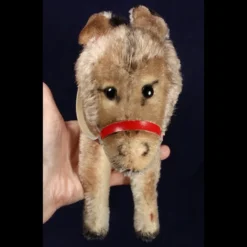
Speaking of his ears, I am always amused when I describe this guy (which is infrequently because of his rarity) because his ears are attached to his head BACKWARDS from the way a real donkey’s are. Just look up “donkey” on Google, and you will see what I mean.
The only additional thing I can think of to mention is the fact that Esel’s eyes are glass, which you probably surmised based on his age. Of course, if you have a question about anything else, please write.
I am sure Esel will delight his new owner, whether that is you, or, if you can stand to part with him when he arrives, the lucky Steiff (or donkey) collector—or Democrat!— who receives him as a gift.
WHATEVER YOU DECIDE TO DO ABOUT ESEL OR ANY OF MY OTHER STEIFF ITEMS, PLEASE BE SURE TO SEE THE ARTICLE I HAVE WRITTEN ABOUT STEIFF ID FRAUD—INCLUDING COUNTERFEIT CHEST TAGS—(AND OTHER IMPORTANT INFORMATION FOR COLLECTORS). YOU WILL FIND THE LINK ON THE BOTTOM RIGHT OF MY SHOP HOME PAGE UNDER “FAVORITE LINKS.” IF YOU HAVE NOT LOOKED AT IT RECENTLY, I UPDATED AND EXPANDED IT IN DECEMBER, 2022.
| ITEM ID | rl-2837 |
|---|---|
| COLOR | Black, Brown, Gray, White |
| ITEM TYPE | Vintage |
| FINE PLUSH AGE | Post 1950 |
Be the first to review “Sweet Earliest And Next To Largest Brother Steiff Donkey Esel 2 IDs”
Related products




Reviews
There are no reviews yet.