

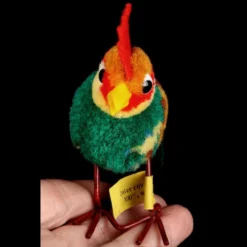
Steiff Early Gorgeous Coloring Nomotta Wool Miniature PomPom Rooster Bird All ID Trailing F Button 1938 To 1943
Original price was: $199.00.$99.99Current price is: $99.99.
- Quality You Can Count On
- 100% High-Quality Guarantee
- 7 days free returns
- We take quality seriously.

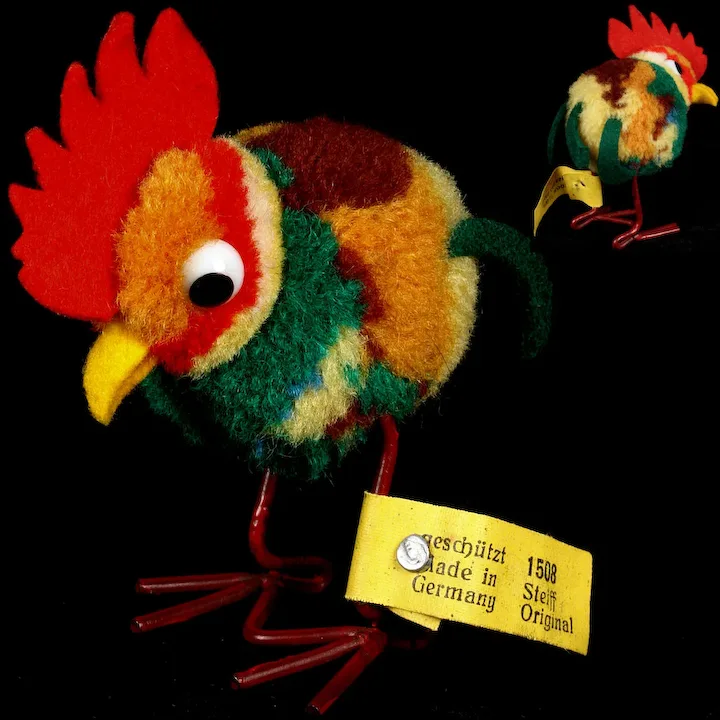
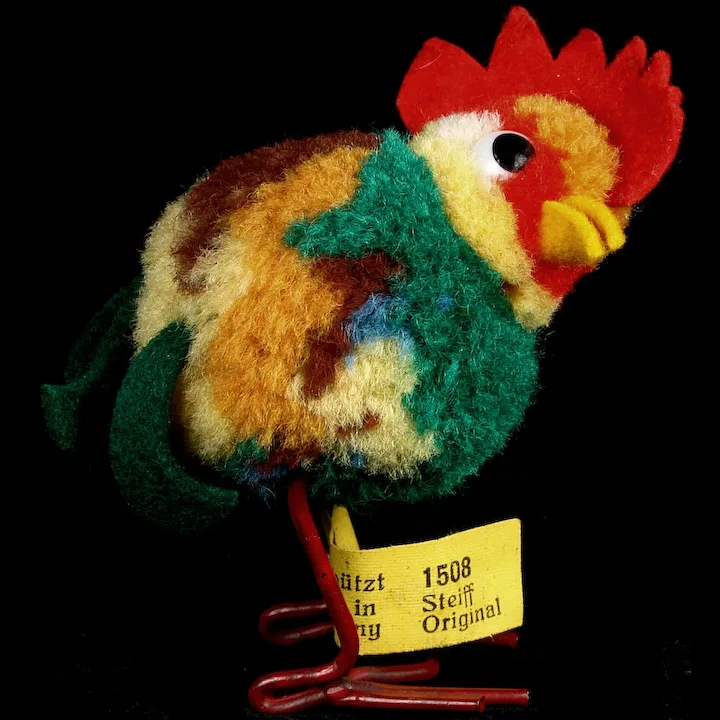
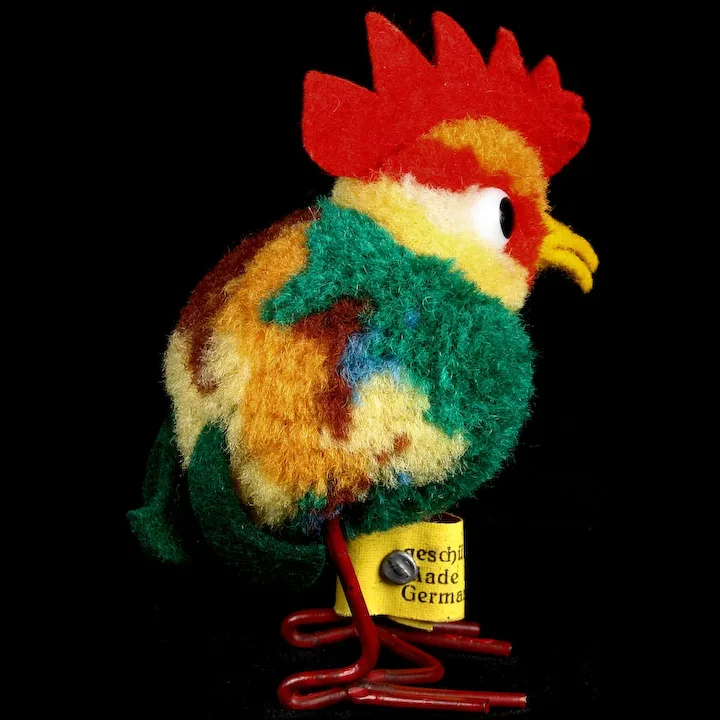
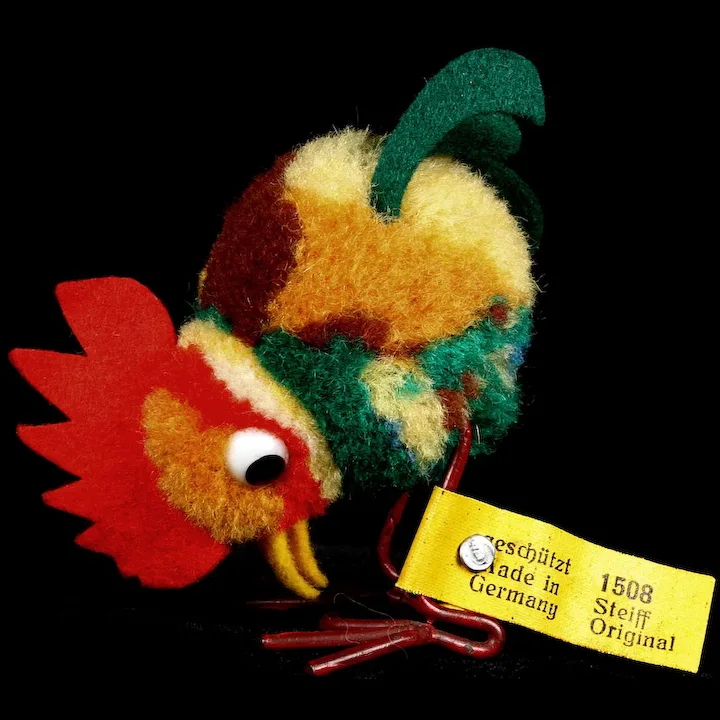
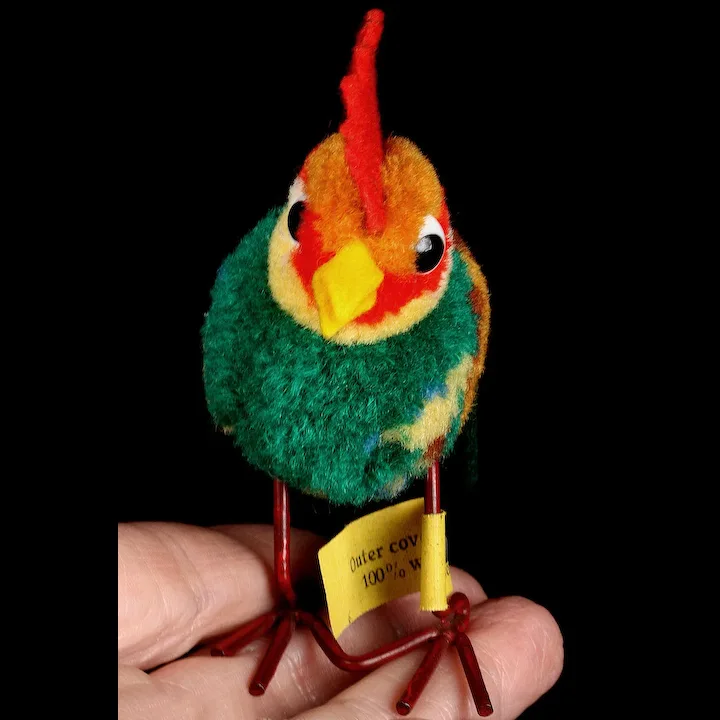
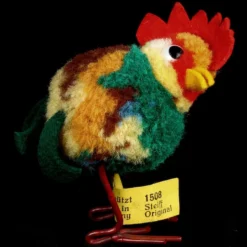
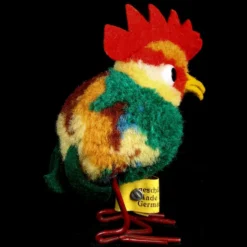
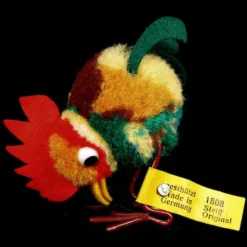
This rare guy would make a nice hors d’oeuvre for one of my feline Steiff critters, but I am sure that you can see his aesthetic and collectible value, even if my kitties can’t. When Hahn (“rooster” in German) is standing erect and not bending over pecking at food (see my sixth image), he is a teeny 2 3/8 inches to the top of his head and about 3 1/8 inches to the top of his felt comb. I am not sure what the “official” way to measure him is, but since his comb is such an integral part of him, I am assuming that is the measurement that matters. If that is true, Hahn is in exact agreement with the catalogue, which lists him as 8 centimeters high. That number is denoted by the “08” in his article number, 1508, which is darkly printed on his flag. That flag, as you can see, is secured by Hahn’s “trailing F” button to his left leg; he has no ears, the usual place to find a button and flag ;-)).
Despite the fact that Hahn’s flag is cloth and not paper, like the flags of most of the wool miniature critters you are likely to come across from the Pre-WWII era, he is not alone. You will see other cloth flags if you carefully scrutinize all the Nomotta wool miniatures in Pfeiffer’s book on antique Steiff. As it happens, the woolie rooster pictured in Pfeiffer does have a paper flag. I don’t know this for a fact, but I believe the very earliest roosters of this series did have paper flags, and for the last years of the series, which ended in 1943, the flag you see is identical to those used just after the war. My guess, therefore, is that Hahn’s “hatching” date was 1940 or later. There is another difference between this guy and the guy in the book, and that is the fact that this guy is much better looking!
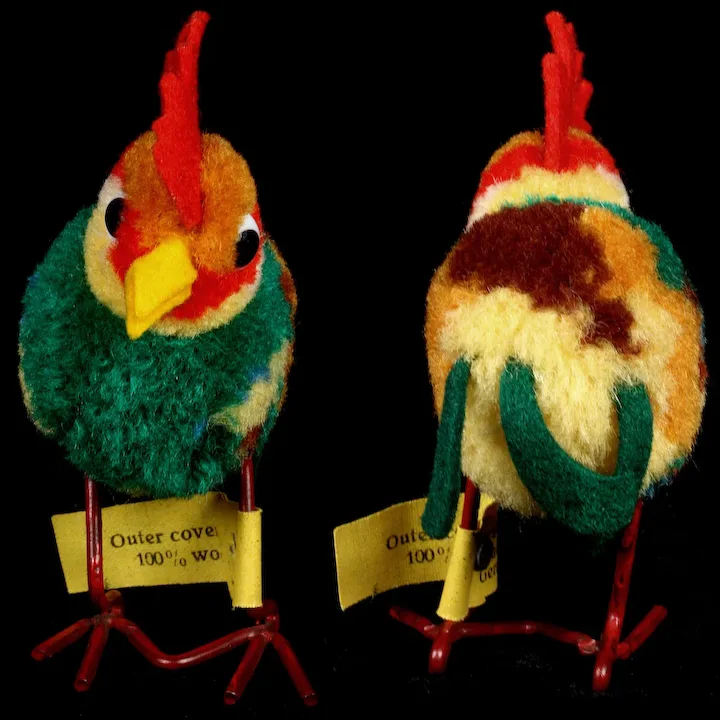
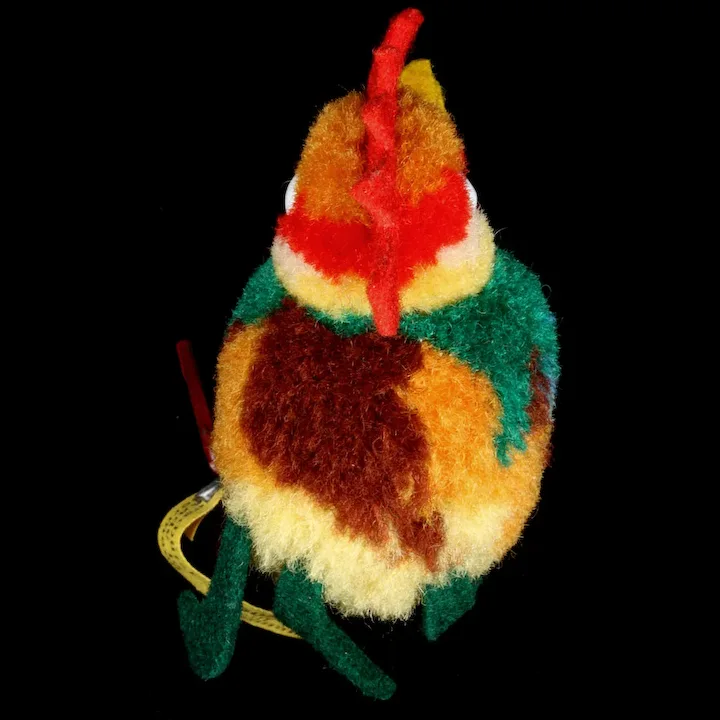
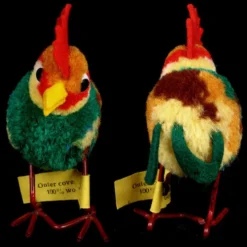
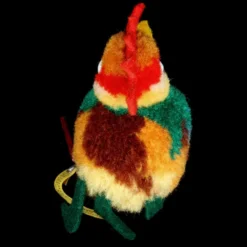
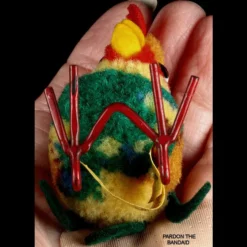
I have a few condition issues to mention, two of which could have befallen Hahn after he left Giengen, and neither of them is very serious. Hahn’s most notable condition feature is the “hatching defect” he received at the factory. But its effect (if any) is negligible and more one of aesthetics anything else. You should be able to see—most clearly in the right half of my second composite image where Hahn is facing away from the camera—that his metal legs were inserted at an angle. His legs are basically an upside down elongated “U” with feet attached, and the “U” was inserted into his body at an angle not parallel to the ground.
I have had bad results when I have tried to straighten out bent metal legs (actually toes on the feet attached to them), and I really did not want to attempt to straighten out the “U” so that Hahn’s legs would emerge from his body perpendicular to the ground. I might have been more willing to take the chance with a pair of pliers, if the angle of his legs were so bad that Hahn could not stand.
Not only can Hahn stand, albeit with somewhat of a lean, 😉 but he will remain in your selected pose all the way up from his pecking pose to standing erect. Some pompom birds just keep bending over to peck at food no matter what position you try to put them in. The wool that surrounds the horizontal bar of the “U” in those birds has gotten too loose to support their little bodies.
To be complete, I will note that Hahn’s wool allows you to rotate him quite freely, so it is not AS tight as some others I have seen. On the other hand, Hahn’s wool is tight enough to pose him in a variety of ways, knowing he will stay posed that way until you decide to change him.
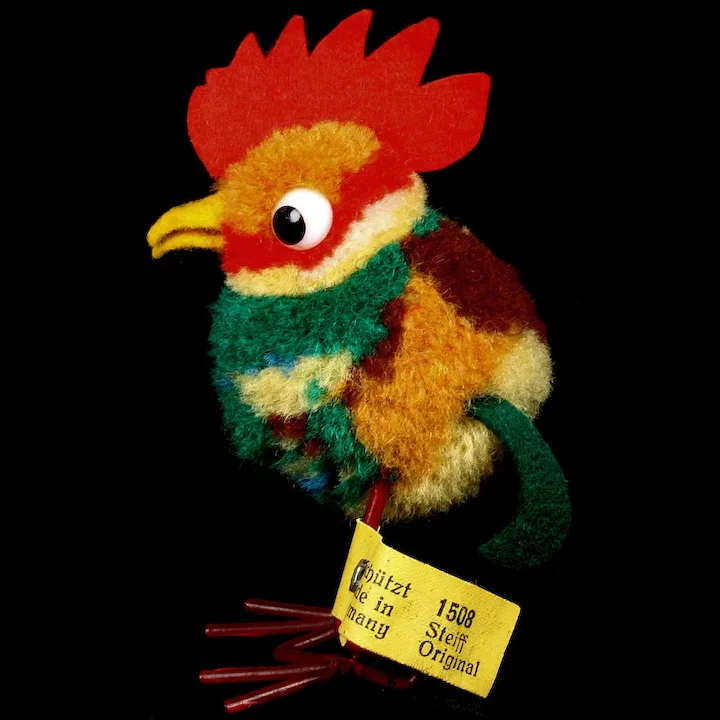
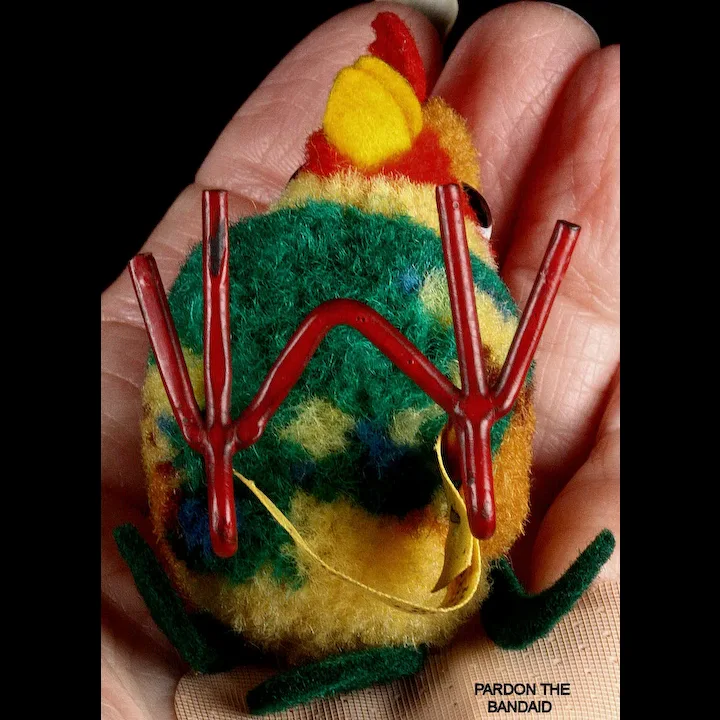
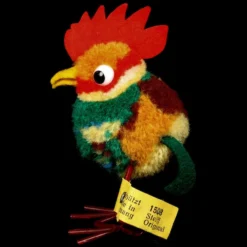
Hahn’s two non-factory issues are really no big deal. The red lacquer covering his legs and feet has worn off in a number of places. As paint coverage on these guys goes, I would say that Hahn’s is above average. As you should be able to see in my eighth image, the worst area of wear is on the bottom of his middle left toe, which, of course, you can’t see because he’s standing on it!
Hahn’s final, and I believe, least significant, detraction is the few tiny pieces of extraneous matter on his comb that may once have been drops of liquid, but have now dried to tiny little specs of debris. I guess I could have tried to (carefully) remove them, but, as is always the case when I decide whether to make a repair on any of my Steiff animals, if the successful outcome of the repair would make very little difference in the animal’s appearance, then I opt for leaving things as they are.
Not counting his legs, even if they have a minor aesthetic component, I would say that Hahn was in at least very good condition, with beautiful colors, tight wool with no lint, and nice posing ability. I mean this absolutely, not the meaningless “for his age,” which is past 80! If you must bring age into it, you can say that he is in very good condition DESPITE his age.
I don’t really have anything else to tell you, except to note that Hahn’s big googly eyes are glass—and they give him such a neat expression! However, please write if you have a question.
I would like to say, as I often do, that this pompom cutie should be in every serious Steiff collection, but he’s much too rare for that! At least, because you are reading this, you have the chance of adding him to YOUR collection, or the collection of the Steiff collector in your life.
WHATEVER YOU DECIDE TO DO ABOUT HAHN OR ANY OF MY OTHER STEIFF ITEMS, PLEASE BE SURE TO SEE THE ARTICLE I HAVE WRITTEN ABOUT STEIFF ID FRAUD—INCLUDING COUNTERFEIT CHEST TAGS—(AND OTHER IMPORTANT INFORMATION FOR COLLECTORS). YOU WILL FIND THE LINK ON THE BOTTOM RIGHT OF MY SHOP HOME PAGE UNDER “FAVORITE LINKS.” IF YOU HAVE NOT LOOKED AT IT RECENTLY, I UPDATED AND EXPANDED IT IN JANUARY, 2023.
| ITEM ID | rl-2743 |
|---|---|
| ITEM TYPE | Vintage |
| FINE PLUSH AGE | Pre 1949 |
Be the first to review “Steiff Early Gorgeous Coloring Nomotta Wool Miniature PomPom Rooster Bird All ID Trailing F Button 1938 To 1943”
Related products

Dolls
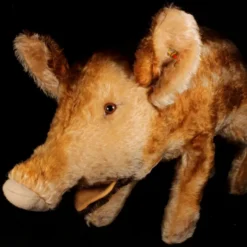
Rare HUGE Unusual Steiff Display Animal Schautier Baby Wild Boar Frischling ID Free US Shipping


Reviews
There are no reviews yet.