

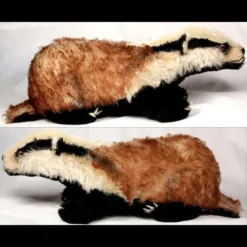
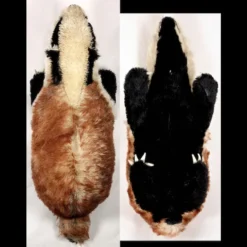
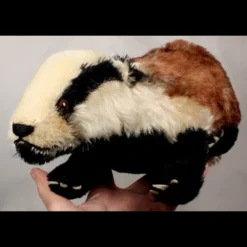
RARE RARE RARE Steiff Big Brother Walking Diggy Badger Dachs ONE YEAR ONLY
Original price was: $169.00.$97.99Current price is: $97.99.
- Quality You Can Count On
- 100% High-Quality Guarantee
- 7 days free returns
- We take quality seriously.

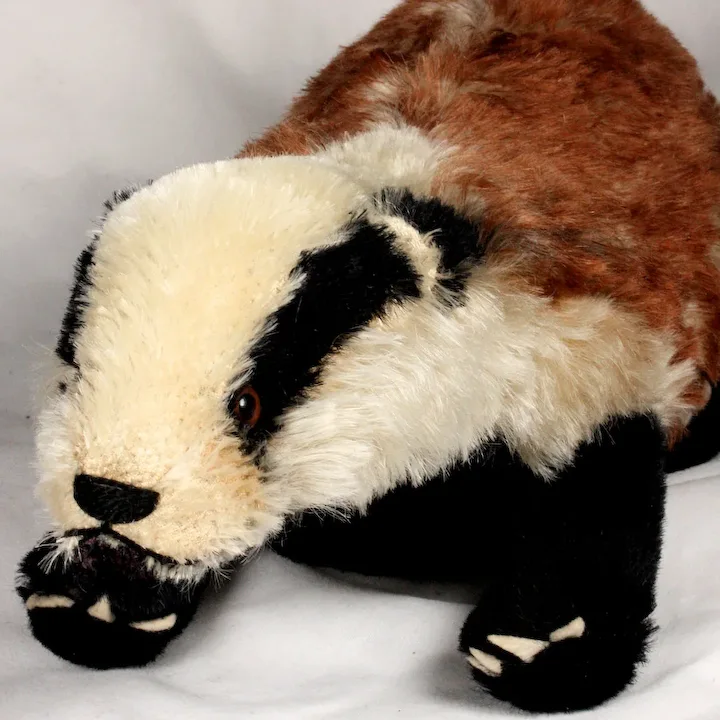
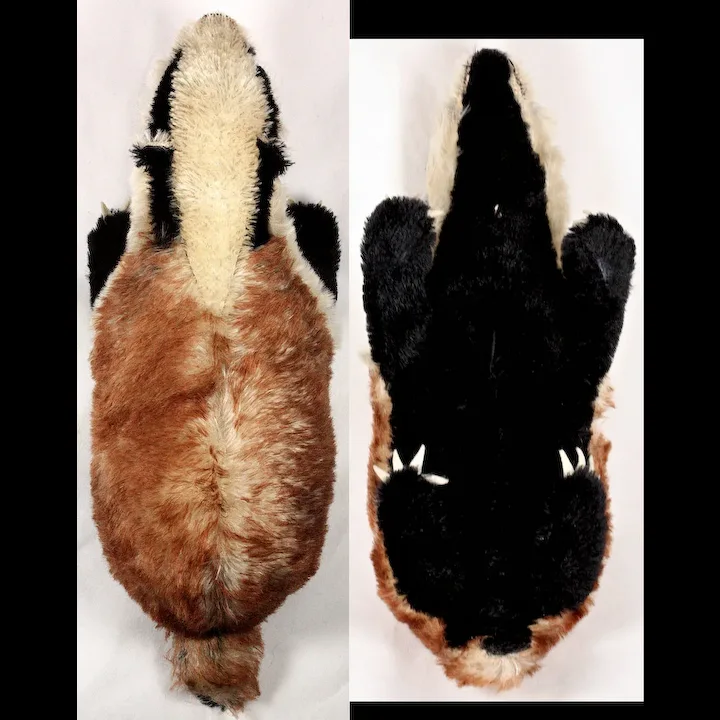
I am delighted to tell you about this new homeless animal who’s requested my help in finding a new den. His name is Diggy, and he’s a badger (“Dachs” in German). Badgers spend lots of time burrowing into the ground—sometimes entering many different burrows they’ve made on a single day, which they use for a number of activities including sleeping, hunting, storing food, and giving birth.
Steiff, as it has done on many occasions, came up with a name that was meaningful to the English-speaking world—sometimes with comical and mistaken results, like “Gaty” as the name for crocodile. ;-). However, in this instance, they got it right. Another word for the verb “burrow” is “dig,” and so this burrowing mammal’s name is Diggy!
Steiff made two versions of the Diggy badgers; the one more commonly seen is the upright “begging” Diggy. That Diggy was made in two sizes, and his “lifespan,” in terms of Steiff’s production, is longer than this Diggy’s. The walking Diggy was also made in two sizes, but for a much shorter period of time than his begging cousin was. AND if Pfeiffer’s information is correct, this Diggy—the larger one—was made for only one year, 1963! Even his little brother was made only one year more, until 1964.
Diggy has lost his IDs, but the raised script button held a flag with the article number 1317,00. The “17” in that number denotes Diggy’s height in centimeters, and because I have never seen one before, I don’t know whether, as with so many Steiff animals, their actual size is different (and the direction is usually smaller) from their catalogue designation. All I can tell you is that by that standard, this Diggy is a runt. He is only 4 inches tall, about 10 centimeters.
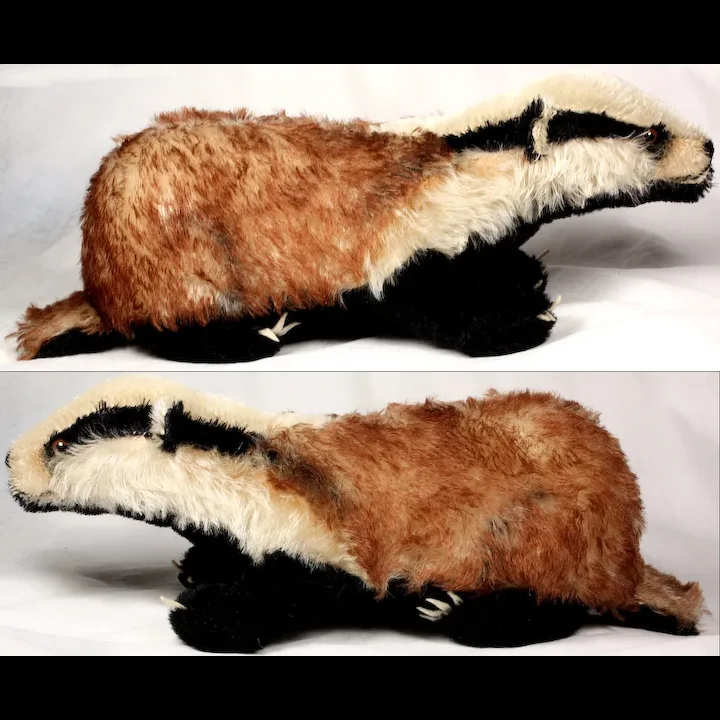
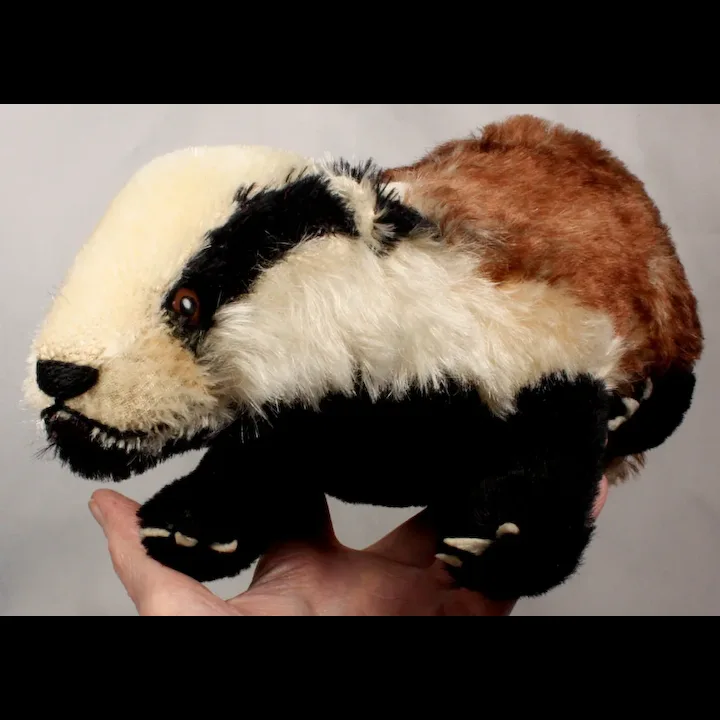
Unlike his height, Diggy’s front-to-back measurement may be something you need to take into consideration when figuring out where and how to display him. He is a bit more than 13 inches long from the tip of his pointy snout to the tip of his extended tail. And, come to think of it, his width may make a difference as well; he’s 5 inches across at his widest point, the outsides of his two front legs.
I was once lucky enough to help the smaller size of the walking Diggy relocate, and I looked up his vital statistics. He was nominally the “10 cm” Diggy, and his height was only 2 3/8 inches! So, based on my admittedly small sample, it appears that the horizontal Diggys are, indeed, runts!
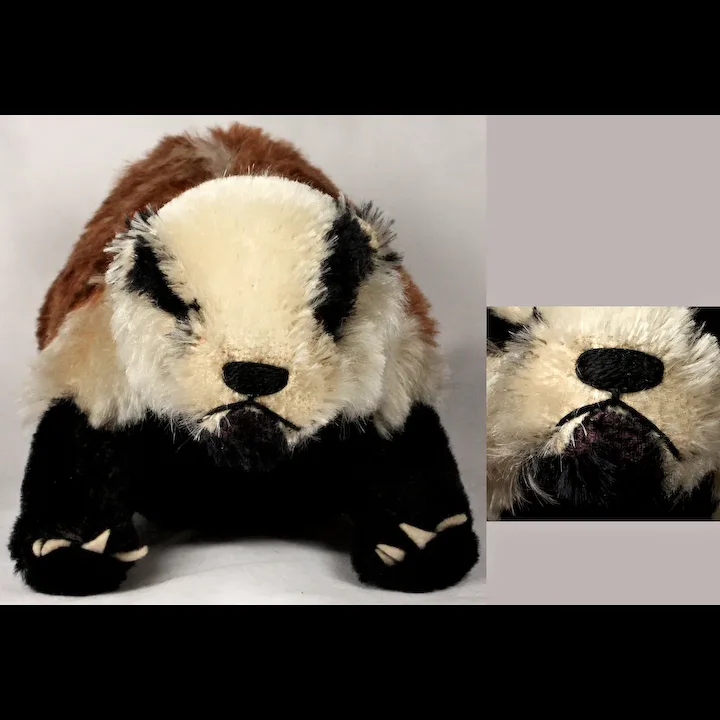
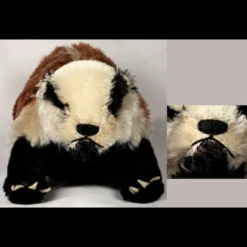
It’s a little difficult to assess Diggy’s condition because I have never seen one of this size to compare. He has some thinning at the end of his muzzle and on his chin (as I am showing you in the inset in my second image). But many animals seem to have this kind of wear, and for some, in any case, I know from sample after sample that the thinner mohair areas you tend to see on their faces are just the way they are made. Two examples I can think of are the Zotty bears, who routinely have apparent thinning on their chins, and virtually all the tabby-striped cats, like Susi, Tabby, and Kitty. Apparently worn muzzles on those cats are so common, I often refer to cat’s apparently worn hair as “cat sparseness,” meaning it is something you see on Steiff cats.
I don’t know whether the big Diggys’ muzzles and chins are always like you see them on this example, although I am slightly more inclined to think the coverage on his chin is wear because of its irregularity. You can see the irregularity because the color of the underlying fabric is lighter than the black mohair.
Even if my thinking is correct about his chin, I don’t think the thinner mohair in either of these areas is any great detraction. While the situation with his chin is a bit more noticeable when you look directly at it, it should be mostly out of view when Diggy stands on display. And while the white area between Diggy’s eyes and nose will be on view when he is displayed, it looks just fine; it is uniformly sparse and blends in with the underlying fabric. This is absolutely equivalent to “cat sparseness.”
Even if BOTH of these thinner areas are wear, they have minimal impact on Diggy’s display appeal, and they don’t incline me to rate him less than “very good.”
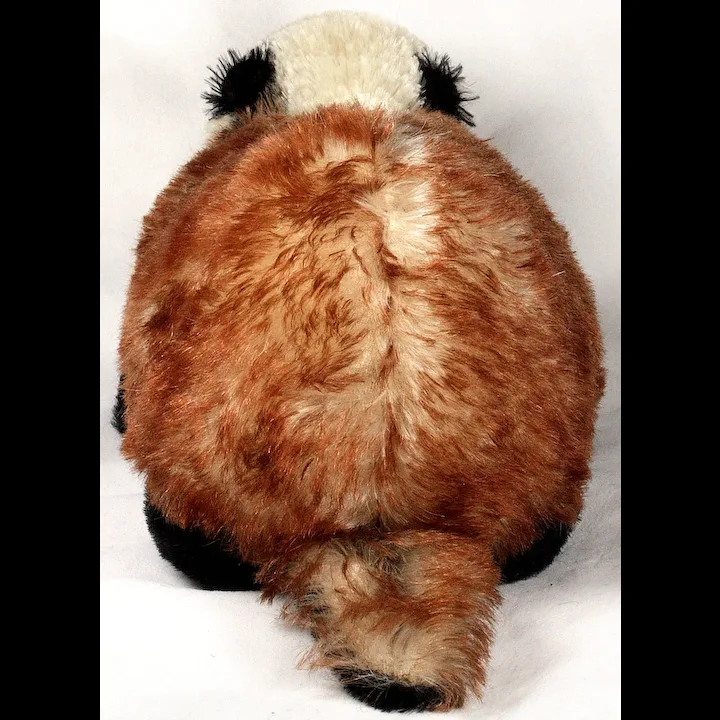
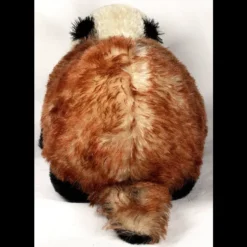
Diggy does seem to have some more conventional wear but this is mainly along his seams. Here and there on his body, there are small thinner areas (NOT MOTH NIBBLES) and they are easily camouflaged by brushing his long hair over them. Just as with his muzzle, I don’t know how typically you see this kind of mohair coverage on Diggys, and, I have to say again, that even if what you find on his body as a whole comes from handling, not manufacture, it is no big deal.
I do have to end this description with my typical comment about Diggy’s muteness. You can feel his squeaker depress when you push in on his belly, but the only sound that causes is the crunch of Diggy’s excelsior stuffing. Because I am assuming that Diggy will be relocating to the home of an adult collector and will be admired from a distance, rather than “played with,” you would not know whether he made a sound or not, just by looking at him.
I can’t think of anything else you’d want to know (of course, his coloring is wonderful and he has his complete set of 16 long felt claws) but please write if you have a question. Diggy is extremely rare in this form AND size, and you should seriously consider adopting him.
WHATEVER YOU DECIDE TO DO ABOUT DIGGY OR ANY OF MY OTHER STEIFF ITEMS, PLEASE BE SURE TO SEE THE ARTICLE I HAVE WRITTEN ABOUT STEIFF ID FRAUD—INCLUDING COUNTERFEIT CHEST TAGS—(AND OTHER IMPORTANT INFORMATION FOR COLLECTORS). YOU WILL FIND THE LINK ON THE BOTTOM RIGHT OF MY SHOP HOME PAGE UNDER “FAVORITE LINKS.” IF YOU HAVE NOT LOOKED AT IT RECENTLY, I UPDATED AND EXPANDED IT IN MARCH, 2023.
| ITEM ID | rl-2864 |
|---|---|
| COLOR | Black, Brown, White |
| ITEM TYPE | Vintage |
| FINE PLUSH AGE | Post 1950 |
Be the first to review “RARE RARE RARE Steiff Big Brother Walking Diggy Badger Dachs ONE YEAR ONLY”
Related products




Reviews
There are no reviews yet.