
Rare Large Steiff Black And White Reclining Cockie Cocker Spaniel Puppy Dog Happy Open Mouth ID
Original price was: $235.00.$98.99Current price is: $98.99.
- Quality You Can Count On
- 100% High-Quality Guarantee
- 7 days free returns
- We take quality seriously.

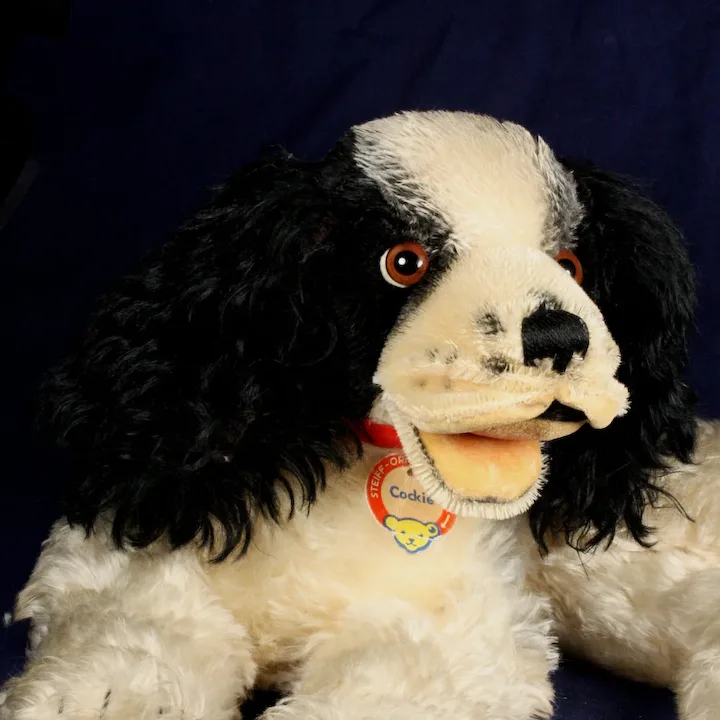
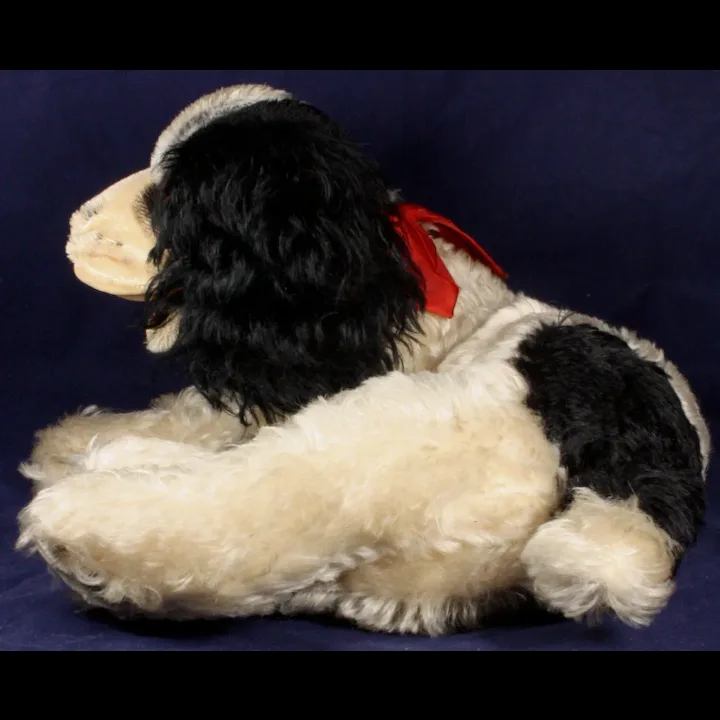
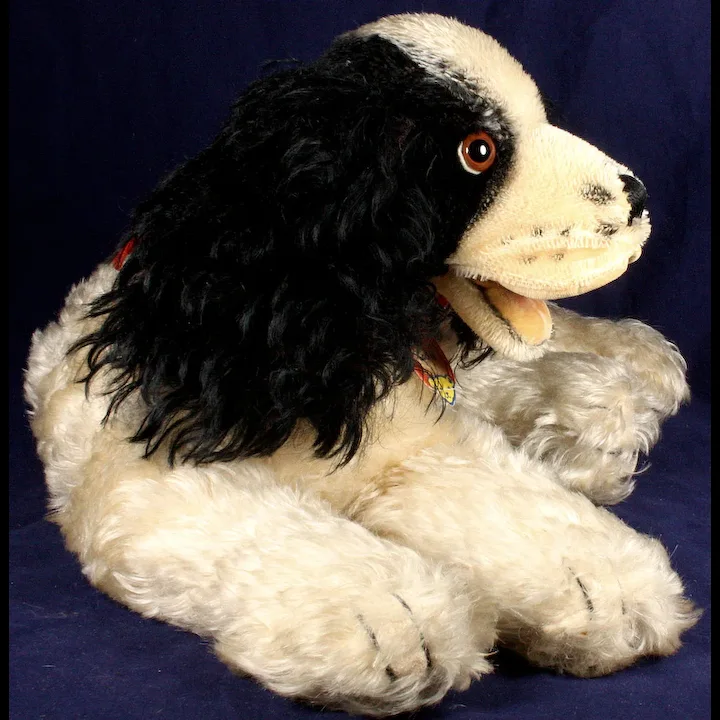
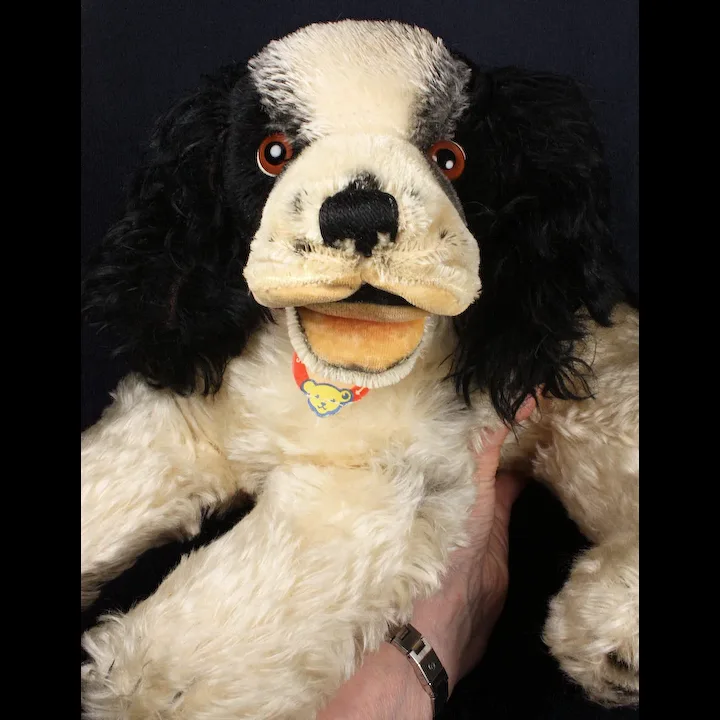
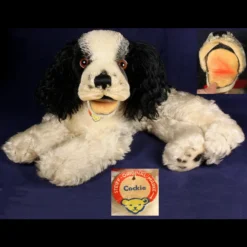
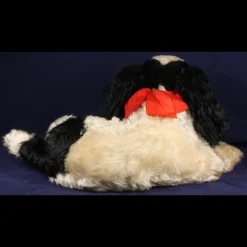
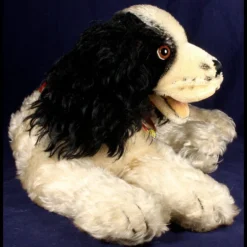
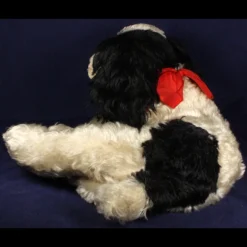
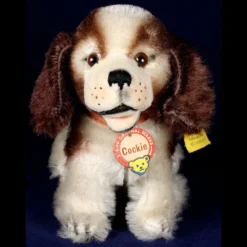
This rare gorgeous doggie’s name is “Cockie,” but except for her happy open mouth, she looks as different as can be from the other rare tiny standing gold Steiff cocker spaniel who recently asked me to help her relocate. These two dogs differ in color, pose, and size, but not in desirability for Steiff dog collectors. Cockie’s appeal is wider than just for canine fans; Even as a Steiff “cat person,” I am happy to have this Cockie in my own vitrine.
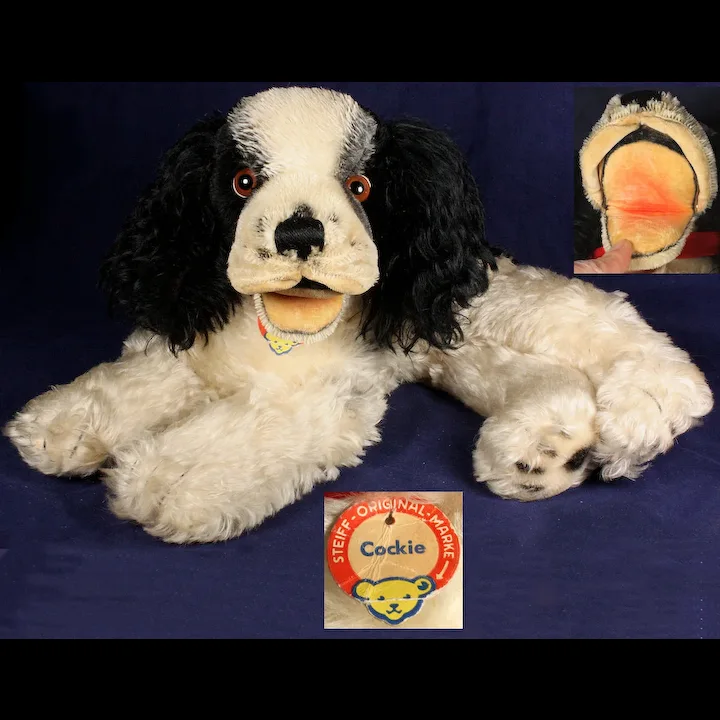
Cockie was made in just this one size, in three series that spanned the years 1955 to 1966. Because she retains only her chest tag (in very-creased but now repaired and in crisp condition), I can’t provide you with any more specific indication of her production date. But nothing much hinges on that; all three series have the same “book value. ” Just for your information, Cockie’s earliest series had article number 2335,1 printed on her flag, and each of the two subsequent series had the number 2335,06.
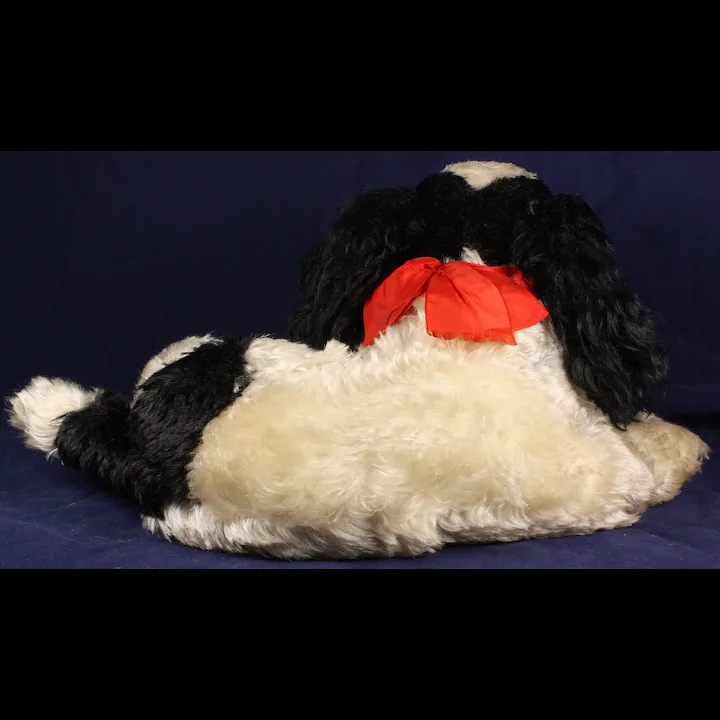
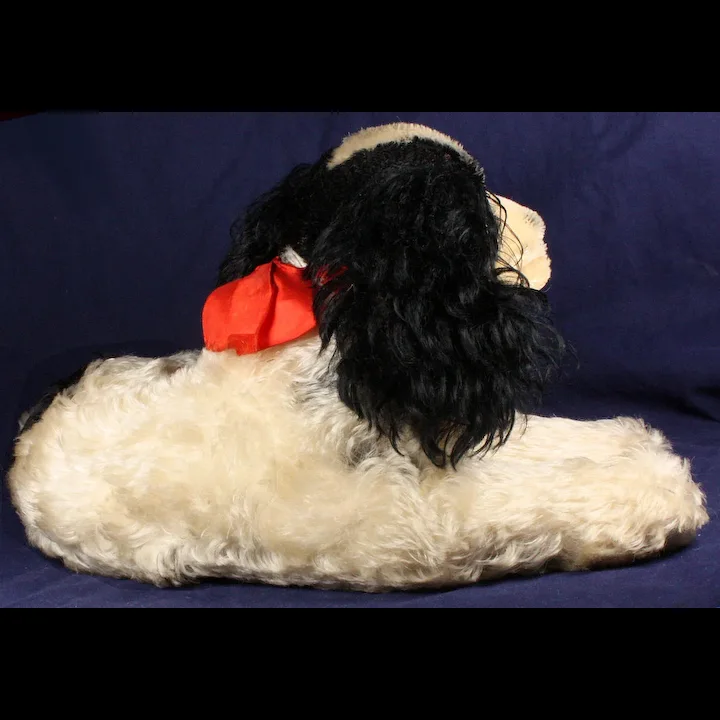
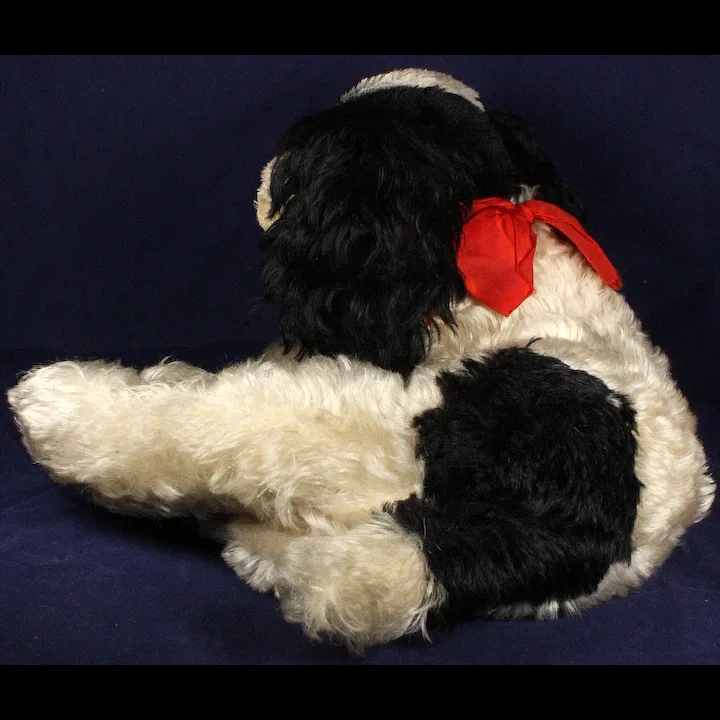
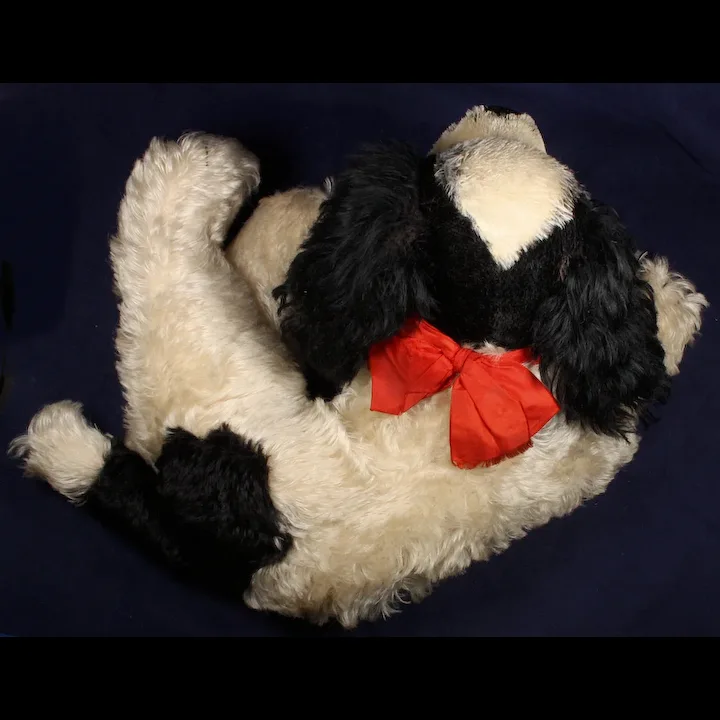
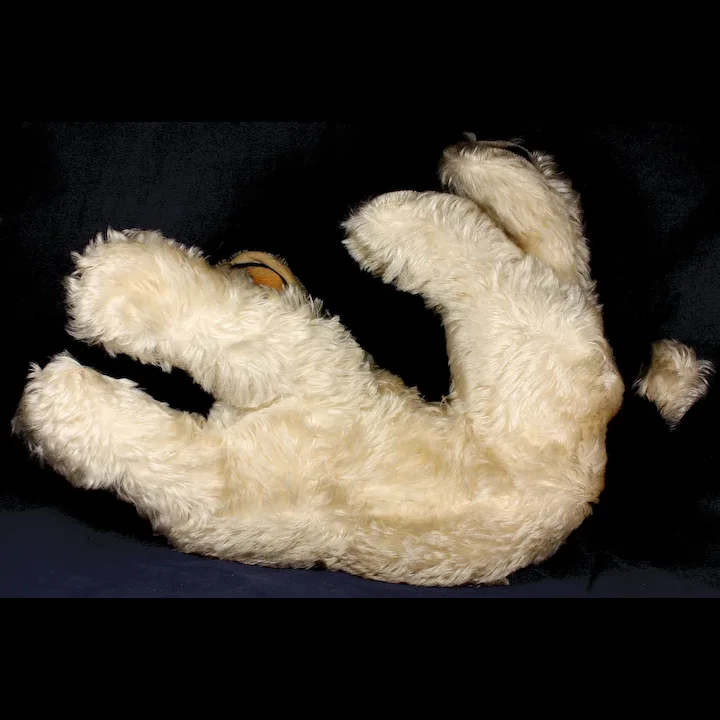
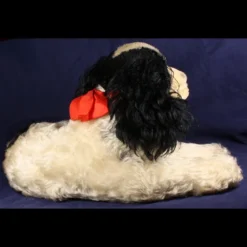
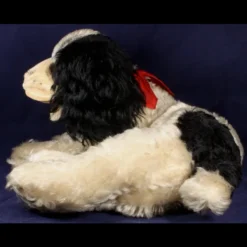
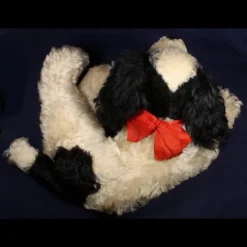
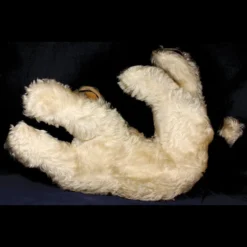
The “35″ in each series denoted Cockie’s size. I am never quite sure how to measure Steiff’s reclining animals to come up with a number that matches their “official” catalogued sizes. In Cockie’s case, I had a relatively easy job of it, since I believe it is as simple as measuring her underside along the line that could be drawn from her right front paw to the outside curve of her body (i.e., excluding her tail). Using that method, Cockie measures almost exactly 35 centimeters, or just over 13 inches. If you want to be sure to have room for her tail, whether or not it is counted as part of her catalogue measurement, you will need a little more room. Cockie measures about 16 inches wide to the tip of her tail. Of course, you don’t HAVE to display Cockie absolutely horizontally, but she is a big girl, and you want her to be comfortable as well as to look attractive on display.
Cockie measures about 8 inches high from the surface she sits on to the top of her (sweetly cocked—no pun intended) head. I have to admit contributing to her good posture with my own infusion of kapok stuffing added to Cockie’s chest and legs. As is often the case with soft kapok, Cockie’s stuffing had substantially settled, and she looked quite deflated when she arrived; she could barely lift her head. If I did not mention this, you would never have known about her restoration; I got access to both her legs and chest from a small opening I made in the seam between her front legs. By the way, Cockie’s head is permanently in the position you see her in. I thought it might swivel, but I am glad I did not try TOO hard to make her head move. 😉
Using her vitrine-living sister as my standard, I would say that Cockie is in very good, or even excellent, condition. There are ways in which each Cockie scores more points; for instance, the black freckles on this Cockie’s muzzle are much bigger and darker. On the other hand, her vitrine sister retains a slight touch of rose-colored airbrushing on her jowls, while this Cockie does not.
Both Cockies share a feature that is curious to me. Their midnight black ears could not have been any darker when they left the factory. But the underlying fabric shows through along the ears’ edges and seams (a touch more on this girl). The question is how did the black mohair stay absolutely black while the fabric underneath faded to brown? I have seen this phenomenon on many black-mohair covered animals, and I always ask the same question. Because the color of the fabric showing through is also quite dark, I don’t think it is any big deal.
I guess it is fair to say that this Cockie’s mohair coverage on her ears is not QUITE as dense as her sister’s, and maybe in those less dense areas, enough mohair was gone to expose the fabric underneath to fading. I have devoted much more time to this than it deserves, and you should see that from her pictures!
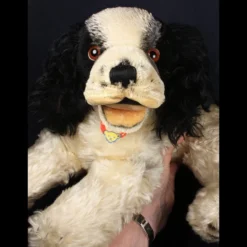
Cockie’s velveteen mouth is in really nice condition, with lots of rose-colored airbrushing. on both her upper and lower palate (which you can see in my inset image where I am holding her mouth open). You can also see that the velveteen is clean, something often not the case on animals with velveteen parts. You see only a hint of the inside of her mouth when it is as open as it is naturally due to her construction. But even with her mouth in its “natural” position, Cockie appears to be a happy doggie.
I now come to what is almost always at the bottom of my list of condition issues, since it has so little bearing on the aesthetic display of an animal in your (and my) vitrine. Cockie is supposed to have not one, but a DOUBLE, squeaker. I have felt around her sides and bottom and can detect nothing like what even a non-working ordinary single squeaker would feel like when depressed. Because Cockie is stuffed with soft kapok, there is not even the crunch of excelsior I can detect in hard-stuffed animals who have gone mute. Because Cockie’s vitrine-living sister has also lost her bark, I have nothing to guide me on where to look (and feel).
I can’t think of anything else to tell you, but please write if you have a question. If you are Cockie’s new owner, I am sure you will love her. If Cockie is meant as a gift to the Steiff or cocker spaniel enthusiast in your life, you may find it hard to give her up!
WHATEVER YOU DECIDE TO DO ABOUT COCKIE OR ANY OF MY OTHER STEIFF ITEMS, PLEASE BE SURE TO SEE THE ARTICLE I HAVE WRITTEN ABOUT STEIFF ID FRAUD—INCLUDING COUNTERFEIT CHEST TAGS—(AND OTHER IMPORTANT INFORMATION FOR COLLECTORS). YOU WILL FIND THE LINK ON THE BOTTOM RIGHT OF MY SHOP HOME PAGE UNDER “FAVORITE LINKS.” IF YOU HAVE NOT LOOKED AT IT RECENTLY, I UPDATED AND EXPANDED IT IN MARCH, 2023.
| ITEM ID | rl-2984 |
|---|---|
| COLOR | Black, White |
| ITEM TYPE | Vintage |
| FINE PLUSH AGE | Post 1950 |
Be the first to review “Rare Large Steiff Black And White Reclining Cockie Cocker Spaniel Puppy Dog Happy Open Mouth ID”
Related products



Dolls
Rare HUGE Unusual Steiff Display Animal Schautier Baby Wild Boar Frischling ID Free US Shipping

Reviews
There are no reviews yet.