
Rare Handsome And Sweet Big Brother Steiff Renny Reindeer Caribou All ID
Original price was: $225.00.$99.99Current price is: $99.99.
- Quality You Can Count On
- 100% High-Quality Guarantee
- 7 days free returns
- We take quality seriously.

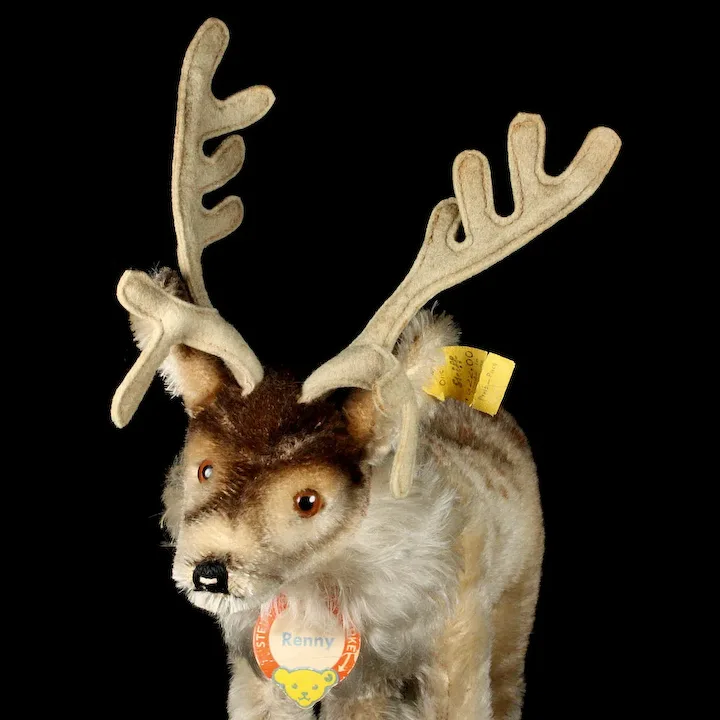
This is the big brother in the Renny Reindeer family (of two ;-)). Renny is fairly rare to see in the secondary market, because his entire production span, running through all his series, was only 1956 through 1970.
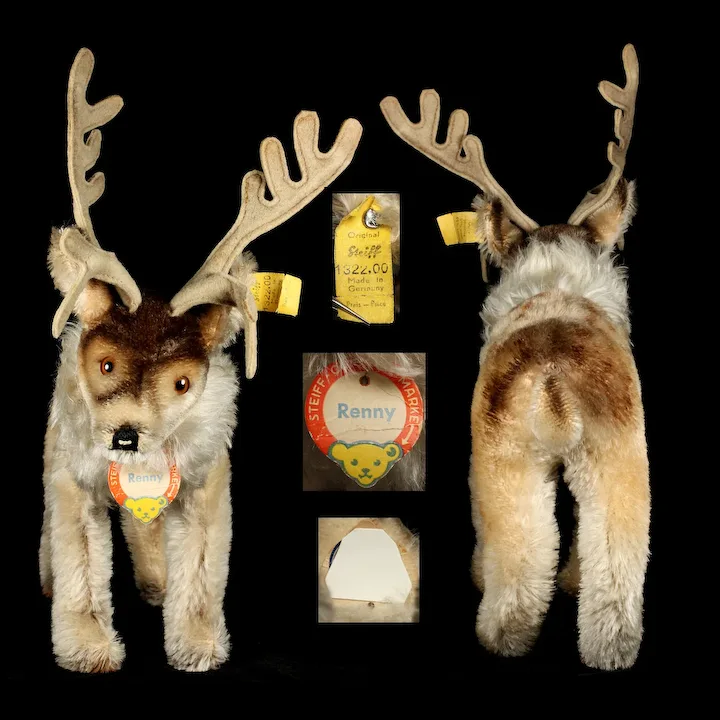
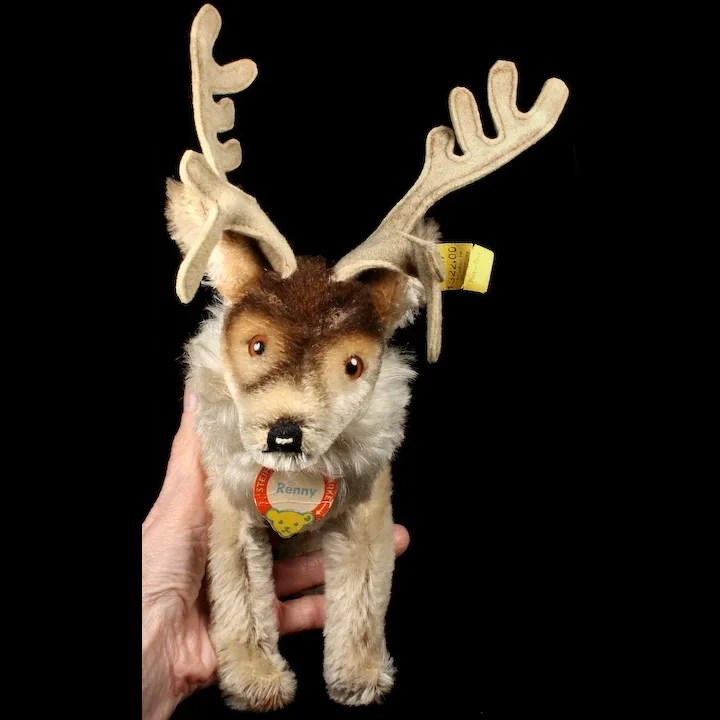
I can date this Renny fairly precisely. His article number, 1322,00, tells you that he is not the very earliest Renny (who had one “0” after the comma). However, there were two series of Renny with this number. I can fairly confidently narrow down Renny’s birthdate to the earlier of the two, which was made from 1959 to 1963. He has two features that differentiate him from the later Rennys. Those two features are his early-style raised script button with skinny letters and his glass eyes. Therefore, even at the youngest he could possibly be, Renny is 60 years old.
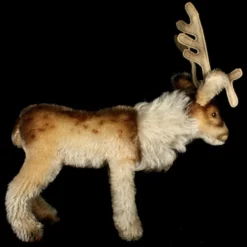
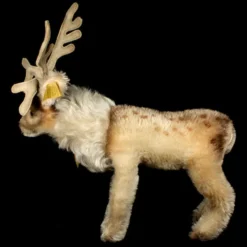
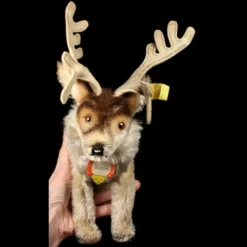
The “22” in Renny’s article number denotes his size in centimeters, and although you’d want to know his entire height up to the tips of his antlers for the purpose of planning a good display spot for him, I believe the catalogue referred to Renny’s height only to the top of his head. By that standard, Renny is a bit of a runt; he measures about 18 cm, or 7 inches, high when measured to the higher side of his sweetly cocked head. This does not include his antlers or his long, alertly-raised ears. Since you will need room for his antlers, you should consider giving him about a foot of vertical clearance, so he won’t get claustrophobia; his right antler is just under 10 inches high.
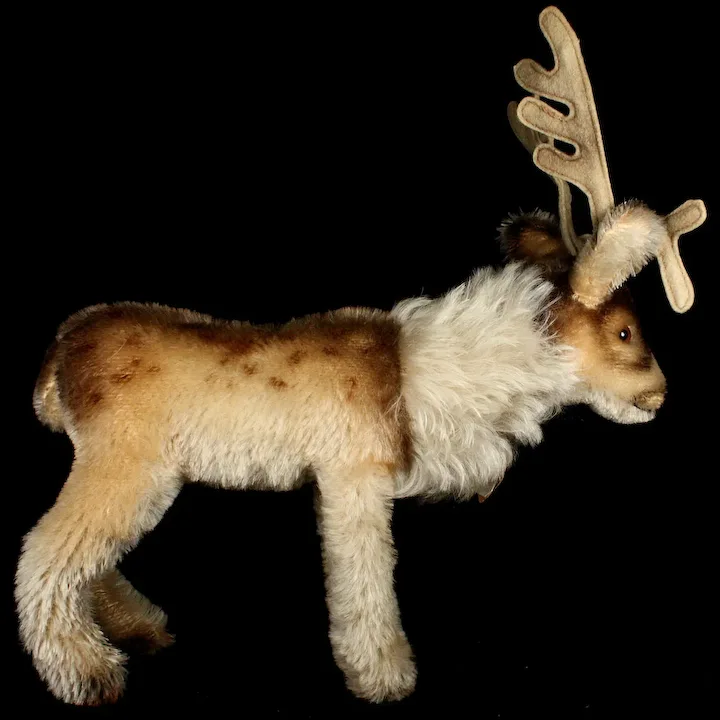
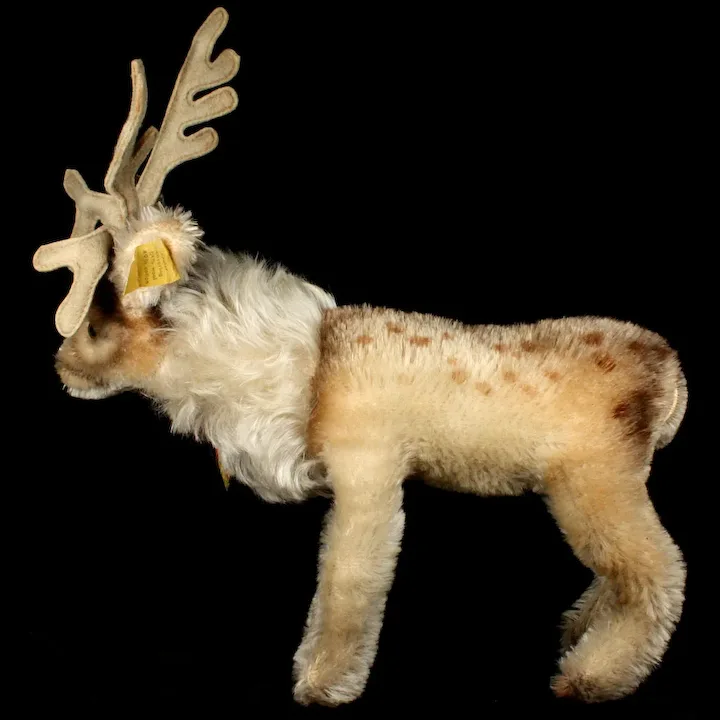
Renny’s antlers are felt, by the way, which is given structure by internal wire. They are stitched to his head securely, although they each have a bit of “play.” As far as I can recall, the Renny brothers, both this one and the little guy, typically have antlers that are not absolutely rigid, and the two siblings in my vitrine are a case in point.
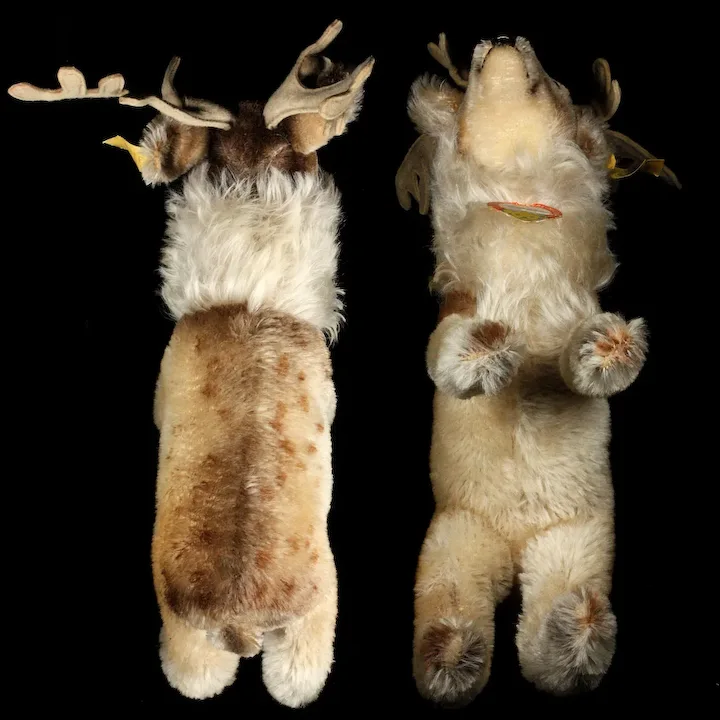
I will be conservative and say that Renny is in very good condition, but that assessment is made DESPITE his age (and play), not “for his age.” I rate my Steiff animals on an absolute scale, since you might come across a pristine antique or, going in the other direction, an animal that was made only 10 years ago who is ready for the trash.
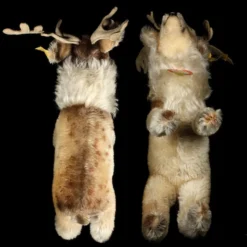
There is no one thing that demotes Renny from “excellent” to “very good.” It is simply that each of the various factors whose consideration adds up to his total condition is just a little less spectacular than it would be if I were rating a new or pristine Renny. Renny has a slight TOUCH of mohair thinning, although most of what I see could be the way he looked when he left Giengen. Two areas that might have suffered a bit of wear are the seam over his left eye (right as you face him) and a few missing hairs under his chin, which are so inconsequential that I have not even bothered to show you a closeup—AND they are out of sight when Renny stands on display.
Still another thing may be the way Renny looked when he was new is the APPARENT fading of his spots on his left side as well as the tan color underneath them before you get to the beige that starts about half way down his back on his right side. I say “apparent,” because that coloring could be the way Renny’s creator sprayed the airbrush gun, and s/he just did not apply the paint symmetrically. That is a reasonable scenario, since the left side of Renny’s face is as dark as the right side, and if he was displayed with his left side facing a window, you would expect his (left) face to be faded too.
Finally, although I typically count a non-working squeaker in an animal that has a “voice” very little, if at all, in my total assessment of its condition, in Renny’s case, his muteness is just one other small thing that was different when he was new.
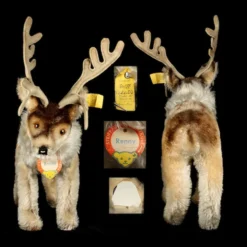
Being thoroughly nitpicking, if I carry out this comparison to include Renny’s IDs, those, too, would not be perfect, although his chest tag and flag are certainly performing their identification function.
Renny’s chest tag had some creases when he arrived, and although none of them threatened to tear, his chest tag did not feel “crisp.” Of course, I could not UNDO the creases, but my cardboard reinforcement on the back of his chest tag makes it substantially crisper to the touch. And nitpicking WITHIN my nitpicking, 😉 I note that the tag’s attachment string has pulled ever so slightly up from the hole, but not even as far as the red periphery of the tag. I am mentioning this to be complete in my description of the tag, but I see no danger of the string tearing all the way up, especially since I am assuming Renny will be joining the collection of an adult.
In contrast to his chest tag, there is very little to say about Renny’s flag. It has some wear, but it is totally legible and still includes—a bit precariously—the price segment.
I can’t think of anything else you’d want to know, but please write if you have a question. Renny can join your Steiff collection (or the collection of the Steiff lover in your life) right now; there is no “season” for reindeer (whose larger version is known as a caribou), but he will be on hand for Christmas.
WHATEVER YOU DECIDE TO DO ABOUT RENNY OR ANY OF MY OTHER STEIFF ITEMS, PLEASE BE SURE TO SEE THE ARTICLE I HAVE WRITTEN ABOUT STEIFF ID FRAUD—INCLUDING COUNTERFEIT CHEST TAGS—(AND OTHER IMPORTANT INFORMATION FOR COLLECTORS). YOU WILL FIND THE LINK ON THE BOTTOM RIGHT OF MY SHOP HOME PAGE UNDER “FAVORITE LINKS.” IF YOU HAVE NOT LOOKED AT IT RECENTLY, I UPDATED AND EXPANDED IT IN MARCH, 2023.
| ITEM ID | rl-2877 |
|---|---|
| COLOR | Beige, Brown, White |
| ITEM TYPE | Vintage |
| FINE PLUSH AGE | Post 1950 |
Be the first to review “Rare Handsome And Sweet Big Brother Steiff Renny Reindeer Caribou All ID”
Related products
Cats
Rare Sweet 17 CM Steiff Black Cat US-Zone Flag For Halloween And All Year Round 1950-1955 Only!



Dolls
Rare HUGE Unusual Steiff Display Animal Schautier Baby Wild Boar Frischling ID Free US Shipping

Reviews
There are no reviews yet.