





Earliest Series Steiff Middle Brother Hopping Hase Rabbit Bunny All ID
Original price was: $169.00.$95.99Current price is: $95.99.
- Quality You Can Count On
- 100% High-Quality Guarantee
- 7 days free returns
- We take quality seriously.

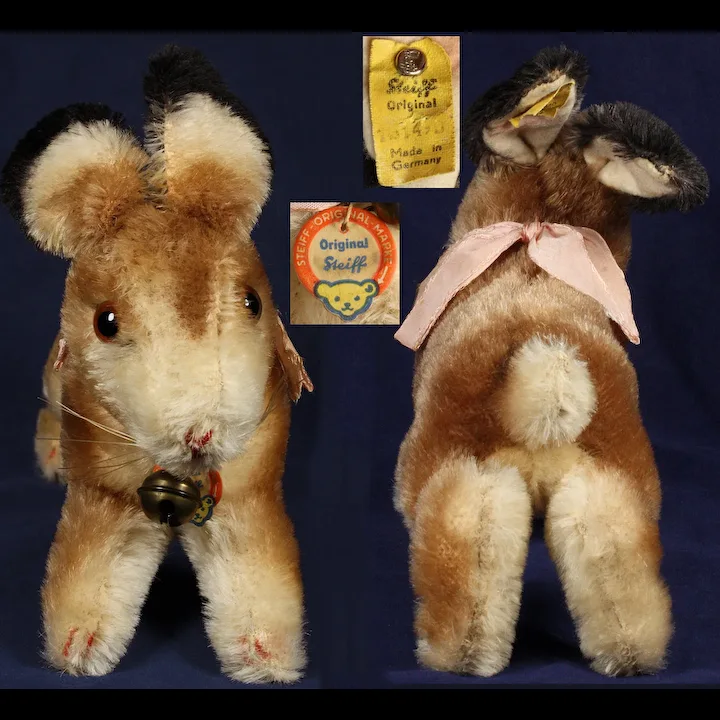
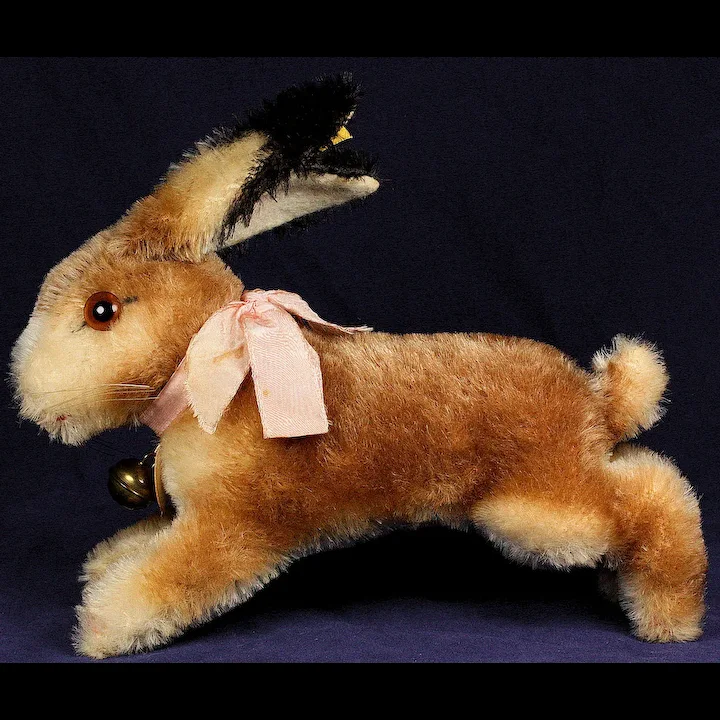
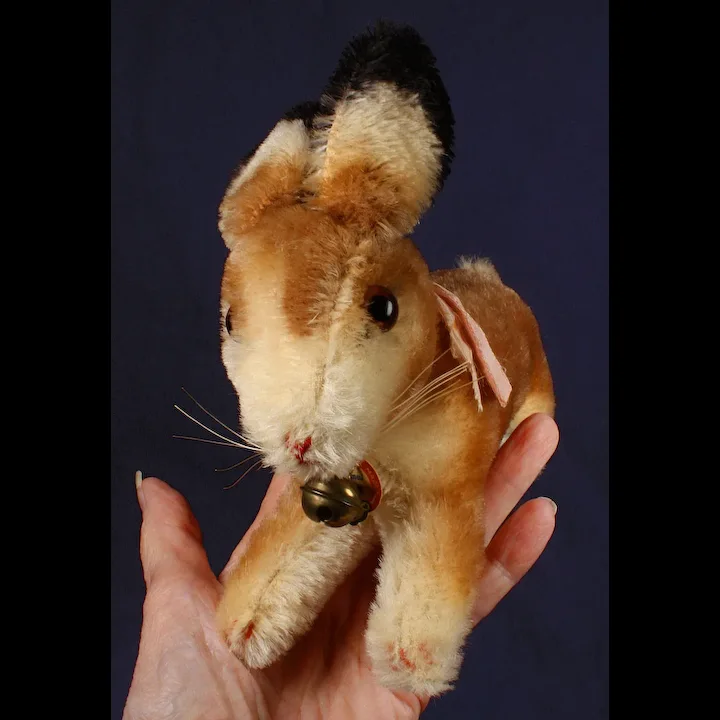
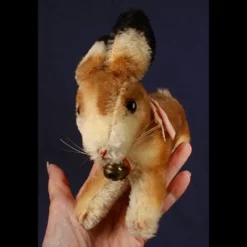
Joining his same-size brother on wheels, I am pleased to introduce you to this early stationary (except in name ;-)) hopping rabbit. Hase is the middle of the three sizes in which this rabbit was made. In later years, this wonderful bunny and his brethren were called “Hoppy,” and that name was printed on their chest tags. But the earliest rabbits in this group had no proper name. Instead, their chest tags said only the words “Original Steiff,” and they were referred to generically as “Hase” (“hare” in German).
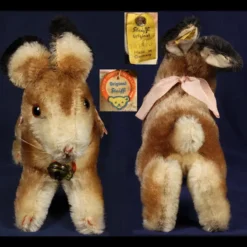
This sweetie’s generic chest tag, by itself, identifies him as early, but since he has complete ID—his early-style raised script button, anchoring his flag (with faded but legible) article number, 1314,0, and glass eyes, I can be fairly specific and tell you that Hase was born sometime between 1953 and 1958.
The “14” in Hase’s number refers to his height measured in centimeters. He’s a bit on the puny side, coming in at a whisker under 12 cm, or 4 3/4 inches to the top of his head. His ears are not the same height, although you could train them to be that way, but, as you see him here, Hase’s height to the tip of his left ear is about 6 3/4 inches. Hase does not have a swivel head, but his natural pose is with his head sweetly cocked to his right side.
Hase is a member of the first series of this rabbit, whose total production spanned the years 1949 to 1958. Because he wears a chest tag (his earliest relatives did not), I can tell you that Hase left Giengen no earlier than 1953. Even if Hase is the youngest he could possibly be, he is in the middle of his seventh decade. Hase does have some condition issues, but each one, by itself, is minor, and because his general presentation is so nice, I feel comfortable saying that he is in very good condition. I am making that determination absolutely, not “for his age,” a way of classifying Steiff animals I find silly and uninformative.
I will, most certainly, give you a rundown of Hase’s issues, but, as I say, his general presentation is really nice.
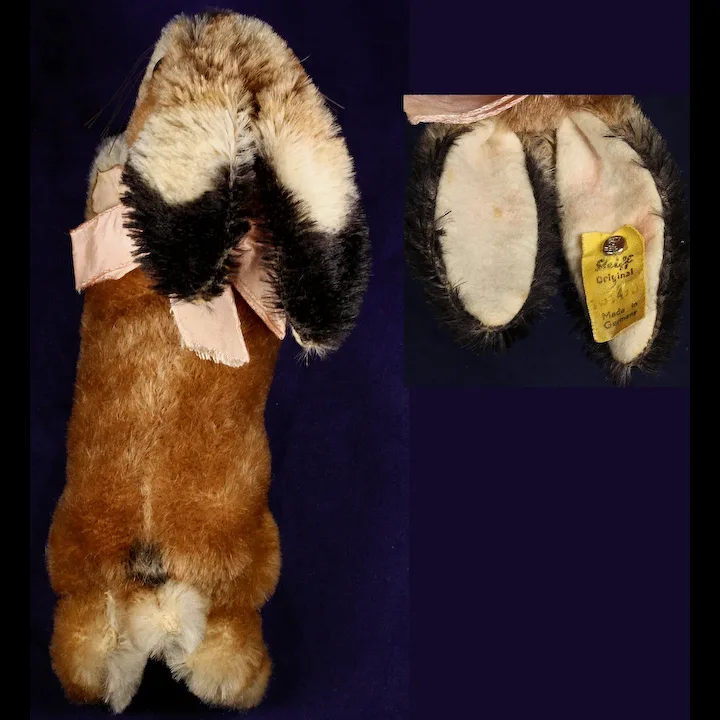
I will start with Hase’s ears, since there are two things I want you to know. The felt insides of his ears have some stains, but their background color is close to the white they were when Hase left Giengen, and they retain a lot of their rose-colored airbrushed accents.
The second thing I want to tell you about his ears pertains to his flag. As I already mentioned, the number is faded, but legible. Probably the most difficult number to read is the “3.” If you know about the meaning of the various digits in a Steiff animal’s article number, that knowledge would help you decipher the “3.” The second digit in a vintage animal’s article number refers to the fabric they are covered with. Since you know that Hase is mohair, you would also know that the second digit is a “3.” If you didn’t know that, you can look in Pfeiffer. 🙂
Another thing I want to tell you about Hase’s flag is the fact that the button holding it to his ear has loosened somewhat in its ability to grab his ear. That is because the lower prong (when you are looking at the flag in the direction meant to read it) has slipped downward, widening the opening it makes in the felt. I did not want to raise the flag too much to see the precise degree of loosening, for fear I could make it worse. Often, I will be content to leave a flag with only one secure prong attachment the way I find it, but in this case, the prong at the top of the flag is dangerously close to the edge of the flag, and that edge has begun to fray. I decided the prudent thing to do was to anchor the flag directly to Hase’s ear with a few tiny stitches. Although you can see the stitches if you look really closely, from an ordinary display distance you would not see them. And that is especially true because you will very likely want to display Hase looking out from your vitrine, and because the undersides of his ears will not be seen, you won’t see them anyway.
I do want to mention one more thing about Hase’s ears, and it is POSITIVE! The black sections of his outer ears do not have any fading at all. In fact, that is my reason for using a blue background instead of the black I typically favor. If I had used a black background, those beautiful black expanses of his ears would have been gobbled up.
Speaking of the color of the background, the blue is not uniform in hue or saturation from image to image. It was more important to me to get Hase’s coloring correct and uniform (and I am not even totally satisfied with that ;-)), and at times my manipulation of his colors had a collateral effect on the background color.
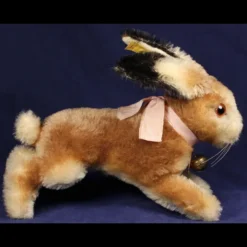
Leaving his ears, the next minor condition issue I want to point out is the fact that there are some stains on Hase’s ribbon. I believe those stains are relatively inconsequential. The pink color of the ribbon does not seem at all faded, and the ribbon has only minor fraying. Lastly, the bow is still tacked to his neck.
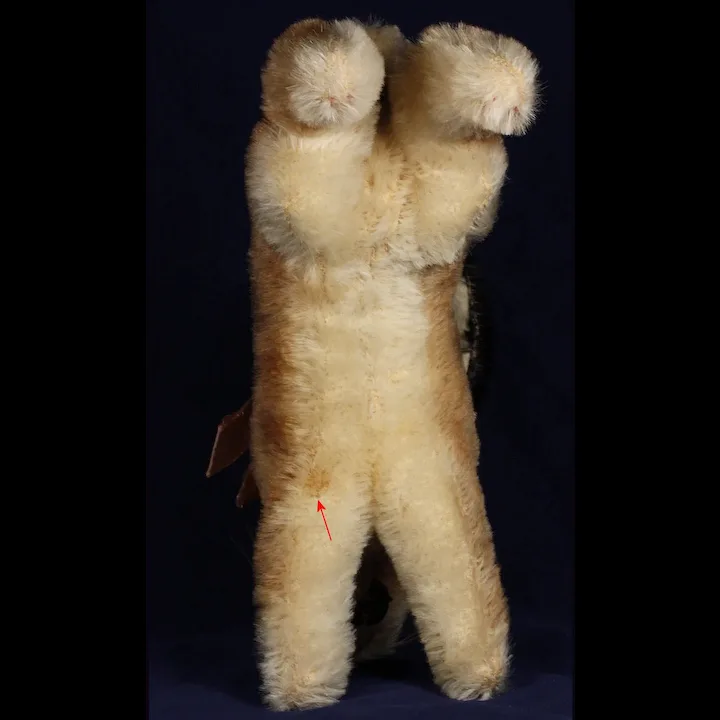
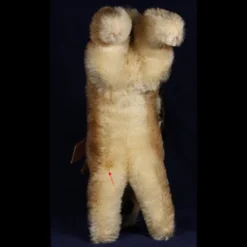
One last stained area is the tiny pencil eraser-sized “dot” I am pointing to in my sixth image. I think it could actually be a wayward spritz from the airbrush gun. Even if that is not the case, the stain is small, and, most important, it is out of sight!
Finally, I want to mention that Hase has some generalized mohair thinning. No one area is egregious, as you should be able to see for yourself.
I do want to end with another positive element of Hase’s condition. He has all 12 of his original whiskers.
As you know if you read my descriptions on a regular basis, I often compare the Steiff animals I am offering to those of the same model who live in my vitrine. In this case, my vitrine Hase is not nearly as nice as this one, and I am not sure that I made the right decision to offer this one to you, rather than keeping him and selling my other. What’s done is done, but I may change my mind. 😉
I believe I have mentioned everything you would think to ask about (and maybe more!), but please write if you have a question. Hase would make a wonderful addition to your Steiff (or other) bunny collection or to the collection of that lucky person who is going to receive Hase as a gift.
If you are in a particularly bunny frame of mind, you should also check out Hase’s many relatives in my shop, including his rolling brother. You will also find more distant relatives—in various positions and made from various materials, also looking for new homes.
WHATEVER YOU DECIDE TO DO ABOUT HASE OR ANY OF MY OTHER STEIFF ITEMS, PLEASE BE SURE TO SEE THE ARTICLE I HAVE WRITTEN ABOUT STEIFF ID FRAUD—INCLUDING COUNTERFEIT CHEST TAGS—(AND OTHER IMPORTANT INFORMATION FOR COLLECTORS). YOU WILL FIND THE LINK ON THE BOTTOM RIGHT OF MY SHOP HOME PAGE UNDER “FAVORITE LINKS.” IF YOU HAVE NOT LOOKED AT IT RECENTLY, I UPDATED AND EXPANDED IT IN MARCH, 2023.
| ITEM ID | rl-2974 |
|---|---|
| COLOR | Black, Bronze, White |
| ITEM TYPE | Vintage |
| FINE PLUSH AGE | Post 1950 |
Be the first to review “Earliest Series Steiff Middle Brother Hopping Hase Rabbit Bunny All ID”
Related products
Cats
Rare Sweet 17 CM Steiff Black Cat US-Zone Flag For Halloween And All Year Round 1950-1955 Only!

Reviews
There are no reviews yet.